

Milan
Milan is an interactive calendar gadget designed to help Indian middle-class families organise and manage their schedules.
By offering a shared platform for tracking personal and family events, Milan ensures that all family members can easily coordinate and stay connected.
Overview of Process
…
Primary Research:
Contextual Inquiry
To study our users we conducted in-home interviews, and inquired about their interaction with household calendars. While most use some form of a calendar regularly, there are a few people that don’t. We tried to understand the reasons behind this.
Focus During Interviews
Interaction with digital vs physical calendars.
Keeping track of children’s lifestyles (and other family members’ schedules).
People’s individual styles of scheduling (notes, annotations, digital reminders, etc.).
Focus During Interviews
What information goes into writing and scheduling, and what is simply remembered.
Scheduling common family events such as planning family trips.
Collaborating with other family members by syncing and sharing about their events.
Interpretations
The data gained from the contextual inquiry was then transcribed as User Statements and Observations. Discussing with the team, we further analysed the data to draw Insights, Design recommendations and Breakdowns.

Work Models
While interpreting the interviews, we sketched work models to organise the data on how users interacted with and were influenced by their surrounding people, places and things.


Shared calendars we found in people’s homes and the variety of information that was marked on them.

Observation:
Physical calendars have the advantage of being constantly visible and accessible. This allows people to quickly jot down handwritten notes.
Takeaway:
Physical calendars serve as persistent visual reminders, that can be revisited throughout the day.
Artefact Model of a real User’s Personal Diary.

Observation:
2 different levels of viewing time are used; a detailed account of each day as well as significant events of the entire month.
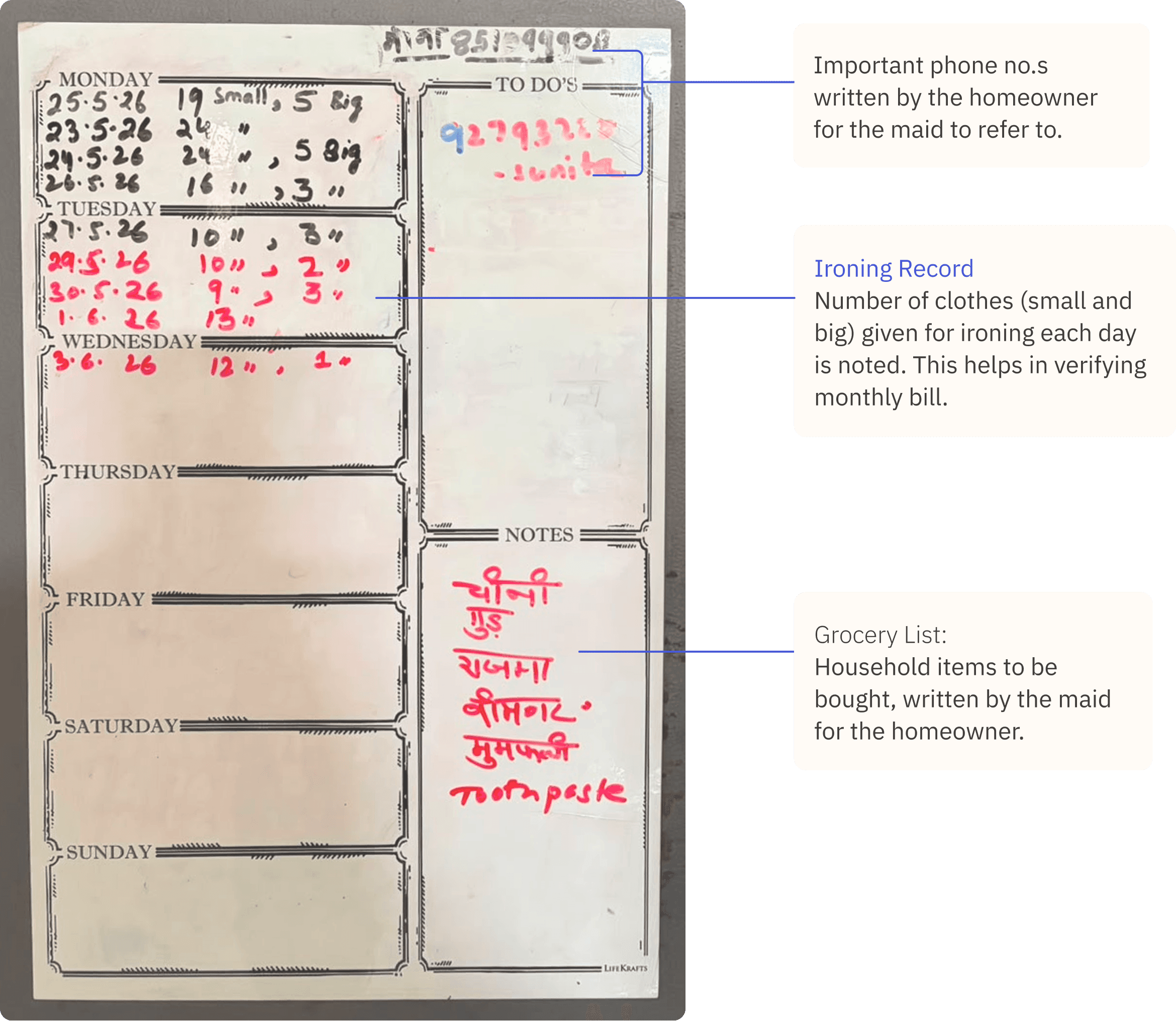
A whiteboard on the refrigerator used by the maid for household notes.
Observation:
Since the homeowners are working during day, the maid cannot call them to inform every update. The whiteboard serves as a simple way to communicate important information between different members of the household.
Takeaway:
A shared, highly visible space for quick notes enables seamless communication among household members.
Affinity Mapping
Using a bottom-up method we arranged user statements, insights and breakdowns from our interpretations into an affinity mapping. This helped us narrow down to the most important insights.

Get a closer view:
Sharing the Right Amount
Space constraints in Printed vs Digital Calendars
Tactile is Intuitive and Involving
Non Standard Legend
Need for Speed
Regional Calendar trends
Event distance and recall
Capturing Additional Information
Competitor Analysis
We analysed some existing products in similar market spaces- Notion Calendar, Google Calendar, Kalnirnay app, Jain Panchang App and Amazon Echo Show 15.
This is an analysis of features that makes them stand out and areas where there is room for improvement.

Takeaways
Feature-rich platforms like Notion and Google Calendar are powerful for planning, but many features are difficult to discover, reducing their usability for everyday users.
These calendar apps also lack deep localisation, offering limited support for Indian languages and regional or religious calendars.
Religious calendar apps provide extensive information but suffer from clutter, making navigation difficult and preventing seamless integration with users' daily schedules.
Home organisers like the Amazon Echo Show 15 combine multiple functions in one device, but their interface and physical design do not effectively communicate their role as a family planning tool.
Key Insights
We further organised the insights gathered using the MoSCoW method. This helped in prioritisation.


Personas
Meet the Mukherjee family!


Usha Mukherjee
68 Years Old
Retired School Teacher
Religious
She takes pride in telling her family about upcoming festivals and religious events. But finding Bengali religious calendars in Mumbai is a huge struggle. She tries to get calendars from her hometown of Kharagpur, whenever she visits, and otherwise relies on updates from her sister. She used to try finding the dates online but is not very good with technology and has given up on trying.
Shweta Mukherjee
39 Years Old
Housewife
Stay-at-home Mom
Loves Family
Shweta manages most household related chores and supports her son’s studies. She also maintains a log for all the household expenses, including ironing of clothes, groceries, maid salaries, etc. But when she’s in a hurry, she forgets to properly structure them. The expenses remain disorganised despite trying different apps and systems.
Since she stays at home all day, her favourite part of the day is when the whole family comes together for dinner. With her husband regularly traveling and her son having classes most evenings, there is very little overlap.


Vishal Mukherjee
42 Years Old
Sales Manager
Struggles with Communication
For his job, Vishal has to travel upto 2 to 3 times a month. Due to this, he finds it difficult to manage his work schedule with his family duties. Often there ends up being miscommunication regarding his availability on a particular day and this causes a lot of upset in the family. He wishes to be able to clearly communicate his travel dates with his family so that they can plan events accordingly.
Aarav Mukherjee
12 Years Old
7th Grade Student
Hates Exams
Aarav has weekend football classes as well as tuition classes 4 days a week. The timings for his tuition often change based on his tutor’s free time. Aarav’s mother has joined his tuition’s WhatsApp group but she often forgets to inform him about changed class timings. He gets to know these at the end moment.
He hates exam time, and likes to count down the days left for his exams to be over and his freedom to begin! Despite getting scolded for it more than a couple times, he often crosses out dates on the family calendar, which is the only calendar he sees everyday.

Information Architecture
The interface is designed with fewer levels of hierarchy, making it easier for less tech-savvy users to find the functions they need in fewer steps. Thus, the information architecture is wider than longer.
Conceptual Model
Our product consists of a Calendar Gadget paired with a companion app. The gadget enables the whole family to view and add entries at home & the app allows individual members to access and edit the calendar when away from home.
